



Cannes Heritage
About thirty Cistercian monks, an abbey founded around 410, an eight-hectare organic vineyard, and an 11th-century fortified monastery tower built to defend against Saracen raids: just twenty minutes from Quai Laubeuf in Cannes, Saint-Honorat Island remains one of the oldest monastic centers still in operation in the West.
Why do we refer to the Lérins Islands in the plural?
The Lérins Islands archipelago lies across from the Bay of Cannes, 1.5 km from Cap de la Croisette. It consists of two main islands and two islets, separated by narrow channels where a few sailboats still anchor year-round.
Two Islands, Two Destinies
Sainte-Marguerite, the largest (152 hectares), is still known for its Fort Royal, where the Man in the Iron Mask was imprisoned between 1687 and 1698. Saint-Honorat, seven times smaller (40 hectares), has remained the abbey’s continuous property since the 5the century: It is one of the very few monastic sites in the West to have maintained its religious use without any major interruptions for more than 1,500 years.
Two uninhabited islets designated as a nature reserve
Saint-Ferréol and La Tradelière, two small islets located east of Saint-Honorat, are home to yellow-legged gulls and Mediterranean shearwaters. Anchoring is not permitted there: they are part of the public maritime domain and are designated as a biological reserve.
Arrival by sea: the only way to get there
The only way to reach the two islands is by boat: 15 to 20 minutes from the port of Cannes, 25 minutes from Mandelieu-La-Napoule, about 30 minutes from Juan-les-Pins. No bridges, no land shuttle service. This isolation by the sea largely explains why Saint-Honorat has retained its monastic character over the centuries.
Around 410: Honoratus of Lérins founded the monastic community
Around the year 410, a young Roman from Narbonne in Gaul named Honoratus arrived on an island that was then covered with pine trees and rockroses and, according to tradition, infested with snakes. Together with a few companions, he founded a monastic community inspired by the Eastern models he had encountered during a pilgrimage to Egypt and Palestine.
A School for Bishops of the Christian West
The rule was strict, but the abbey quickly attracted the intellectual elite. During the 5the and VIe During the 4th century, according to monastic sources, Lérins produced nearly six hundred saints and bishops, including several major figures:
- Saint Vincent of Lérins (died around 445), author of the Commonitorium, a theological reference manual
- Saint Césaire of Arles (470–542), future bishop of Arles and theorist of Western monasticism
- Saint Loup of Troyes (383–479), Bishop of Troyes
- Irish tradition also recounts a passage from St. Patrick in Lérins before his missionary work in Ireland
The Legend of the Palm Tree and the Cannes Palm
An ancient legend recounts that upon his arrival, Honorat is said to have unleashed a tidal wave to drive away the snakes that were infesting the island, while he himself took refuge at the top of a palm tree. This image has become part of local iconography: the palm tree still appears on the coat of arms of the city of Cannes.
Fifteen centuries of trials and rebirths
The abbey survived the Saracen invasions (the martyrdom of five hundred monks in 731, according to tradition, and recurring raids until the 11the (13th century), the decline of the Middle Ages, the Renaissance commende, followed by the Revolutionary dissolution of 1791 and the auctioning off of the estate. In 1869, Cistercian monks from Sénanque bought the island and reestablished monastic life there. The current community, the direct heir to this revival, consists of about thirty monks. For more information, visit the official website of the Lérins community explains the liturgical rules and calendar.
Viewing the Island from the Boat: Six Landmarks to Look For
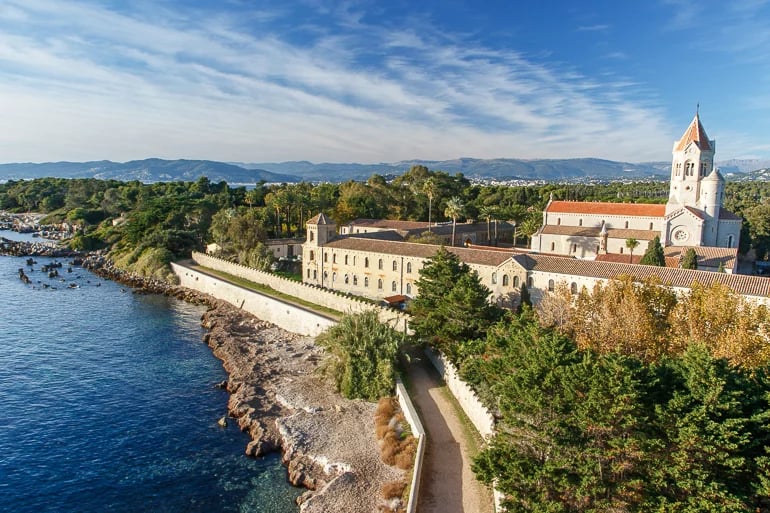
Viewed from the south, Saint-Honorat Island reveals a two-part architectural structure: the medieval defensive complex on one side, and the modern contemplative complex on the other. Six main features stand out when viewed from the sea.
The Fortified Monastery Tower (1073)
Built around 1073 by Abbot Aldebert II in response to Saracen raids, the monastery tower is the most visible feature from the sea. With four levels stacked around an inner cloister, a cistern at the base, and a chapel at the top, it is one of the very few surviving examples of Mediterranean monastic military architecture. Its square silhouette, standing right at the water’s edge, gives the island its distinctive visual signature, recognizable from afar.
The 19th-century Neo-Romanesque abbeye century
Behind the tower, the Abbey of Notre-Dame-de-Lérins—rebuilt after 1869—features a long Neo-Romanesque structure made of light-colored stone. It houses the convent church, the monastic cloister, the refectory, and the cells. This area remains closed to the public except during services and retreats.
The seven scattered chapels
Seven chapels scattered across the island mark a prayer route historically traveled by monks: the Chapel of the Trinity, the Saint-Sauveur Chapel, the Saint-Caprais Chapel, the St. Peter's Chapel, the Chapel of the Holy Cross and two others. Several date from the Middle Ages and were restored in the 19the century. All are open to visitors outside of retreat periods.
The Vineyards of Saint-Honorat
The monks grow eight hectares of vineyards on the island, using certified organic farming methods. The grape varieties are Mediterranean: Syrah, Mourvèdre, Viognier, and Chardonnay. The winery produces two lines of AOC Côtes de Provence wines (reds, whites, and rosés) and three monastic liqueurs, including the famous Lerina distilled since the early 20the century, using about 40 aromatic plants. It is one of the very few wineries in France still run by monks.
The pier on the north coast
The only landing place is on the north coast, facing Cannes. This is the only authorized landing spot for visitors: the rest of the coastline is protected.
The Coastal Trail
A three-kilometer trail circles the island, passing by the chapels and offering direct views of Cannes Bay to the north and the open sea to the south. It takes about an hour to walk at a leisurely pace.
Approaching Saint-Honorat by boat: three best times to go
Saint-Honorat can be explored in three distinct stages, each revealing a different aspect of the monastic island.
In the morning, for the light and the peace and quiet
The first departures (around 9 a.m. from the Laubeuf pier in Cannes) coincide with the end of the monastic service. The low-angle light illuminates the fortified tower from the east, creating ideal conditions for photography. The island is still relatively uncrowded, and you can walk the entire coastal trail with the feeling that you have the island all to yourself.
The afternoon: wine tasting and visiting the chapels
A shop near the landing stage offers tastings and direct sales of the estate’s wines and liqueurs in the mid-afternoon. This is also the ideal time to tour the chapels in their traditional order and visit the monastery tower, which has been restored and is open to the public.
In the evening for the Cannes fireworks display
The least obvious, but most spectacular view: from the open sea between Saint-Honorat and La Croisette, the Cannes Pyrotechnic Art Festival sets off fireworks over the bay on six evenings during the summer (mid-July through mid-August). Viewed from the sea between the two Lérins Islands, the show takes on an acoustic and visual dimension that’s impossible to experience from the beach: the bay becomes a natural sound chamber, and the fireworks are reflected on the dark water in a 360-degree panorama. The fireworks cruise from Cannes offers precisely this vantage point, with the boat anchored off the islands during the display.
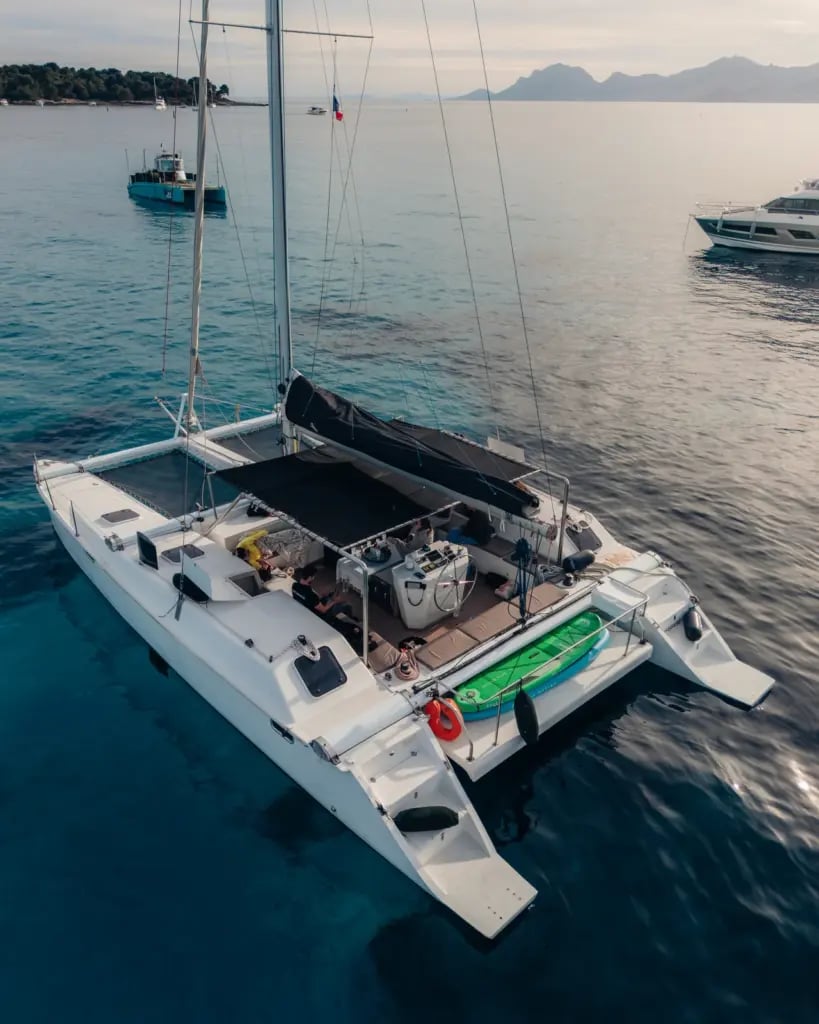
To visit Saint-Honorat at other times of the year, a Boat rental with skipper allows you to combine a tour of the island, a swim in the coves to the south (turquoise waters, rocky seabed), and a return trip along the coast past Sainte-Marguerite.
Approaching Saint-Honorat by sea is to rediscover the vision of its founders: the sea as a protective barrier, isolation as a prerequisite for spiritual life. Sixteen centuries after Honorat’s arrival, the island retains this dual identity: a fortress against the secular world (the monastery tower dating from 1073, the scattered chapels), and a retreat for the monastic community (the Neo-Romanesque abbey, the vineyards, the coastal trail).
This 1,600-year continuity is rare in the western Mediterranean. Viewing it from the sea helps one grasp its scale: an island small enough to remain manageable, far enough away to remain unspoiled, and close enough to the mainland to have survived both raids and revolutions. To maximize the contrast, combine this with a a similar approach to the Rock of Monaco, another layer of medieval history visible from the boat.