

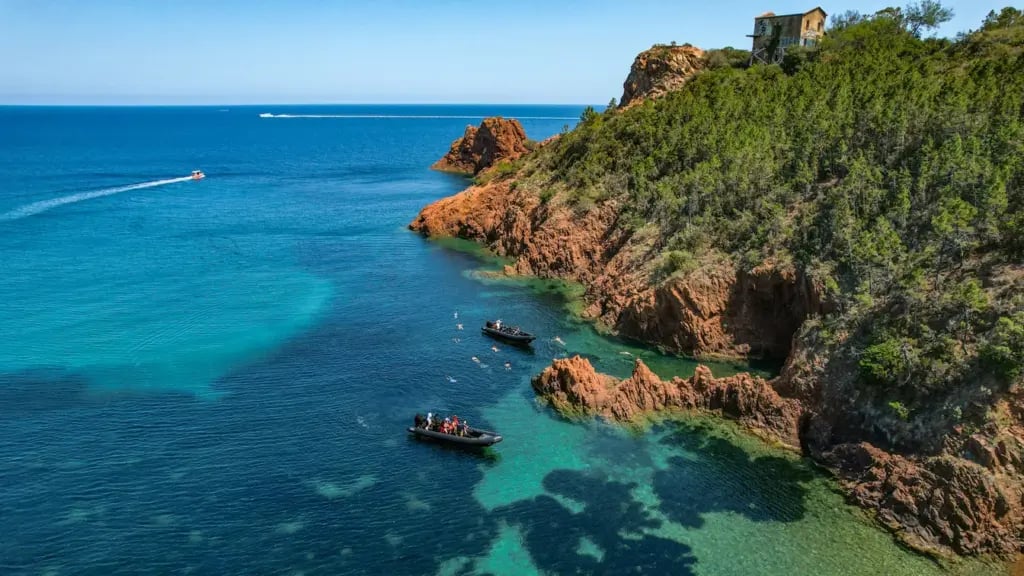
The Esterel massif is red because it is primarily made of rhyolite, a volcanic rock rich in iron, which oxidizes and turns red.
The red color of the rocks in the Esterel is explained by the presence of’Hematite, an iron oxide whose amaranth tint permeates the rhyolite, the main volcanic rock of the massif. Iron oxidized in a hot and arid Permian climate, about 250 million years ago, during the breakup of Pangaea.
Improperly called «red porphyry of the Esterel» by marble workers in the 19th century, this ignimbritic rhyolite exhibits several variations depending on the associated minerals and the surface weathering of the rock.
The five acts of estrellian volcanism
Geologists distinguish five major phases in the formation of the massif:
- 280 million years (Stephanian) first breaks and lacustrine basins to the north
- 270 Ma (Early Permian) black basaltic eruptions, still visible in Aiguebonne
- 255 MA appearance of red rhyolites, emplacement of Mont Vinaigre (614 m), the highest point of the massif
- 235 Ma (Triassic) intrusion of esterellite, the «blue porphyry» of Cap Dramont, mined since Antiquity
- 23 Ma (Miocene) The Corsica-Sardinia rotation separates the Tyrrhenian massif and gives it its current maritime facade.
A unique rock in metropolitan France
While Permian rhyolites are found elsewhere (Monte Cinto in Corsica, Montreuillon in the Morvan region), only the Esterel massif offers this concentration of red hues and the spectacular interpenetration of volcanic relief and coastline. When one travels along the massif from the sea, this scarlet polychrome is seen in successive bands, punctuated by green flows (iron reduction) and gray veins of esterellite.
Three shades of red
The petrographers distinguish in the massif:
- Deep amaranth from rhyolitic ignimbrite, dominant on the peaks of Cap Roux and l'Ours
- The purplish-violet Permian pelites, visible at the Barrot Dome
- Brick red Conglomeratic arkoses, with their visible cemented pebbles on the coast of Anthéor
From the Ligurians to the monks of Lérins: 2,500 years of occupation
The massif has been inhabited since the Neolithic period, as evidenced by the Flint arrowheads found at the Bouverie site (Roquebrune-sur-Argens) and exhibited at the archaeological museum of Saint-Raphaël. But it was with the Ligurians, then the Romans, that the Estérel became a true Mediterranean crossroads.
The Aurelian Way, Roman highway
Built in the 2nd century BC, the Via Aurelia crossed the massif to connect Rome to Spain. Its route followed the more secure northern ridgeline, as opposed to the coast, which was still plagued by piracy, and remains discernible today in certain forest paths of the National Forest Office. Several Roman milestones, including the one at Forum Iulii (Fréjus), bear witness to the intensity of this traffic.
Saint Honorat and island eremitism
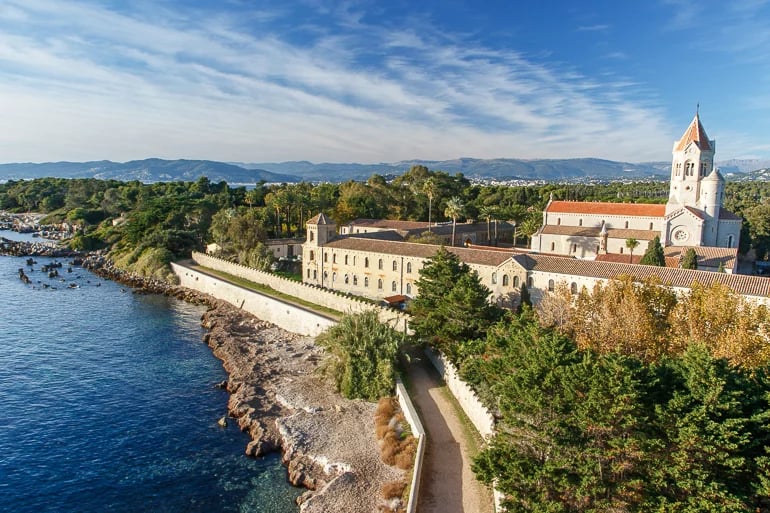
In verse 410, as the Roman Empire collapses, a young Gallo-Roman patrician named Honorat founded a monastery on the nearby island, which would later bear his name: Saint-Honorat, opposite Cannes. The rule he establishes there will give rise to dozens of bishops (Saint Patrick of Ireland is said to have been trained at Lérins) and will make the archipelago a major spiritual center of the Christian West.
The balms of Pic du Cap Roux
The massif itself attracts hermits and monks, who take refuge in the balms (natural caves) of the Pic du Cap Roux. A statue of Saint Honorat still watches over the path that leads to the peak, 453 meters above sea level.
Finding a safe haven in the Esterel Massif, Gaspard de Besse set up his headquarters at the Auberge des Adrets. His motto: frighten, but never kill.
Gaspard de Besse, the Robin Hood of Provence
In the 18th century, the massif again became a haunt, no longer for hermits but for bandits. The most famous figure is Gaspard Bouis, also known as Gaspard de Besse (1757-1781), a blacksmith from Besse-sur-Issole who became the leader of a gang of highwaymen.
From blacksmith's apprentice to outlaw
Born into a modest family, Gaspard quickly took to the maquis and set up his headquarters in The Inn of the Adrets, on the road connecting Fréjus to Cannes. This inn, which still exists today, controlled the only passable route through the Esterel: every merchant, every courier, every traveler had to pass through it.
The Mont Vinaigre Cave
His gang, which numbers up to sixty men, operates from the Cave of Mount Vinaigre, still visible on IGN maps. According to oral tradition, Gaspard redistributed part of his catches to poor peasants, earning him the nickname «Provençal Robin Hood».
«Scare them, but do not kill them.»
His motto, passed down through the chronicles of the time, explicitly forbade him from killing his victims. A directive that would not be enough to save him: betrayed by one of his own, arrested in La Valette in 1780, he was sentenced to the breaking wheel and executed in Aix-en-Provence on October 25, 1781, at 24 years old. His corpse was then hung from a tree in the Esterel to serve as an example.
The Auberge des Adrets, renovated in the 20th century, still has a «Gaspard de Besse» room and is among the major sites on the massif's historical circuit. To discover the Esterel in the way that best reveals its old hiding places, nothing beats a Sea excursion along the massif.
1903: La Corniche d'Or Changes the Destiny of the Massif
For centuries, crossing the Esterel meant taking the high road of the Adrets, a winding and dangerous route. Everything changed on the April 11, 1903, inauguration day of the Corniche d'Or, coastal road connecting Saint-Raphaël to Cannes over 27 kilometers and 183 turns.
Abel Ballif and the Touring Club de France
The opening of the cornice is the work of Abel Ballif, president of Touring Club of France, an association advocating for cycling and then automobile tourism. Ballif convinced the State, the department, and the municipalities to finance this ribbon winding its way along the red rock cliff face, which instantly became the most picturesque road on the French Riviera.
The Anthéor Viaduct
The Anthéor Viaduct, the most spectacular work of engineering along the route, became a recurring motif on Belle Époque postcards. The Corniche d'Or lost its status as National Road 7 in 1935, becoming D559, but its golden nickname remained.
Three perspectives on the massif
With the opening of the Corniche, the Esterel becomes legible from three complementary angles:
- By road : the D559, perfect for capturing the succession of coves and points
- By the paths The GR 49, 51, and 653 trails cross the mountain range, now classified as Natura 2000.
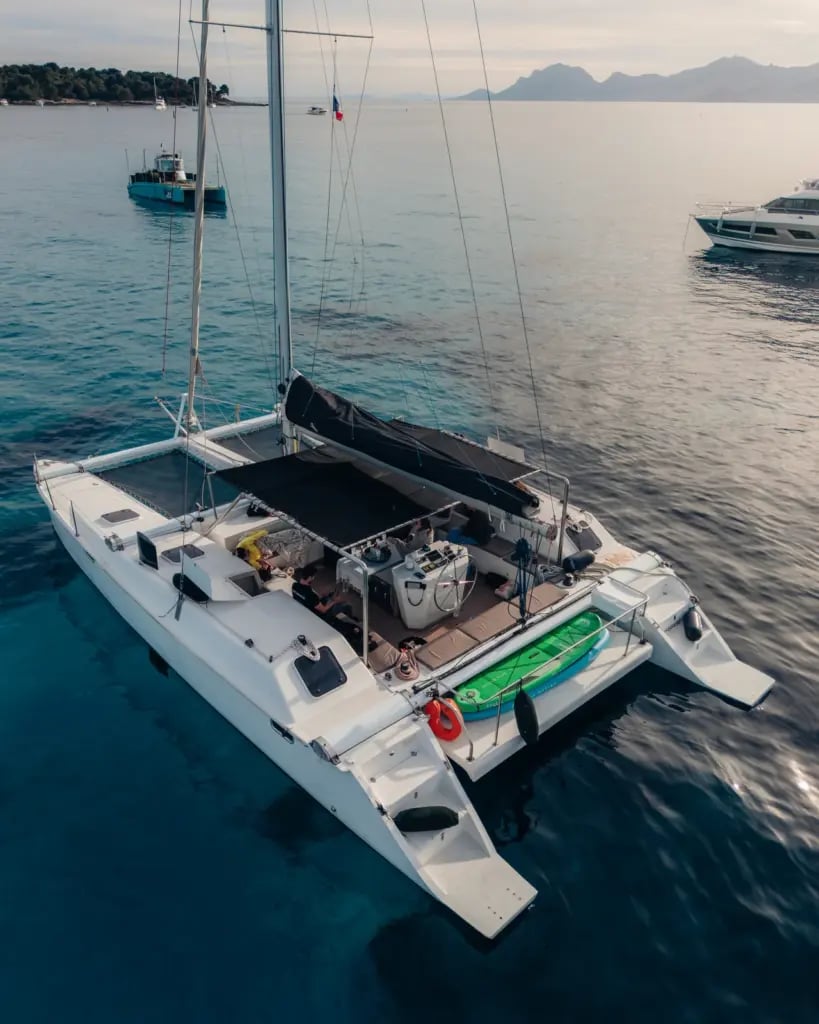
- By sea the only way to discover Coves accessible only by boat, such as Calanque des Anglais or Île des Vieilles
The massif celebrates 120th anniversary of the Corniche d'Or in 2023, without losing its contrasting charm between flamboyant red and deep blue.